
Bluefield Previous Resident Sources
A house history needs records from several eras. Current assessment data supplies a parcel and owner-of-record anchor. Deeds carry the title trail farther back. Directories, newspapers, maps, and probate sources can then add dated clues about people, uses, and buildings. The table marks only coverage supported by Bluefield research; an identified holding does not mean every volume is online or every page has been viewed.
| Source | Years It Covers | Where Held | What It Shows |
|---|---|---|---|
| Assessment and parcel GIS | Current annual assessment cycle | Mercer Assessor and MapWV | Parcel, situs, owner field, legal description, map context |
| Deeds and deed indexes | Deeds 1837-1904; indexes 1837-1968 on listed microfilm | Mercer County Clerk and WV Archives | Recorded owners, roles, dates, and legal descriptions |
| Bluefield directories | Selected years 1917-18 through 2016 | WV Archives, Craft, and other named repositories | Dated address, name, occupation, and household notation |
| Bluefield newspapers | Bluefield Daily Telegraph 1896-2017 | Craft Memorial Library | Obituaries, notices, business and event context |
| Sanborn maps | Sets from 1893 through 1922 context | Library of Congress | Historic street labels, footprints, use, and materials |
| City address files | Confirm with the department | Bluefield Clerk and Engineering | Public permits, plats, zoning, minutes, and project files |
For a recent change, begin with the assessor and Clerk. For a twentieth-century household, start with the nearest directory year, then move to maps and newspapers. For nineteenth-century title work, ask the Clerk and Archives about books or microfilm. Record the source year, repository, role, page or identifier, and whether an original image was checked.
Anchor a Bluefield Address
Begin with a place that can be identified today. Search WV Property Search under Mercer County, then compare the same parcel in the WV Parcel Viewer. Save the parcel ID, GIS ID, physical or situs address, E911 field, district, legal description, owner-of-record field, and assessment date. A situs address means the property's physical location; it may differ from the owner's mailing address.
The current 2026 tax tickets are tied to the July 1, 2025 assessment, so later transfers may not be reflected. The state map also says its parcel lines are best-fit graphics. Use the deeded acreage and recorded plat or survey process for legal questions.
A strong anchor has a unique parcel and two matching non-sensitive facts. It still does not establish who occupies the address. That gap is why previous residents must be checked in dated household sources.
Trace Mercer Deeds Backward
The deed chain follows ownership, not residence. Start with the current Mercer assessment result, then use the legal description and owner name to ask the County Clerk for the recorded purchase instrument. No current official Mercer web deed interface was verified, so the Clerk's counter, phone, mail, and confirmed copy process are the proper fallback routes.
- Copy the assessor's owner field, parcel ID, legal description, and assessment date. Keep the address as a search aid, not the sole identifier.
- Ask for the current owner's acquisition deed. Supply name variants, approximate dates, parcel, address, and any known book, page, or instrument number.
- Read the grantor and grantee roles. Search the seller as a grantee to locate that party's earlier acquisition of the same legal parcel.
- Repeat the pattern. Check corrective deeds, releases, trustee documents, estate instruments, and spelling variants when a link seems absent.
- For earlier years, use the Clerk's deed books or the WV Archives Mercer microfilm list. Confirm copy and certification fees before ordering.
- Grantor and grantee
- The grantor conveys an interest; the grantee receives one. Neither label alone proves residence.
- Chain of title
- The linked sequence of recorded transfers for the same property interest.
- Legal description
- The deed language that identifies land by lot, boundary, or survey terms, often more stable than a street number.
The WV Archives Mercer microfilm list shows the older deed and index runs used in this backward search.
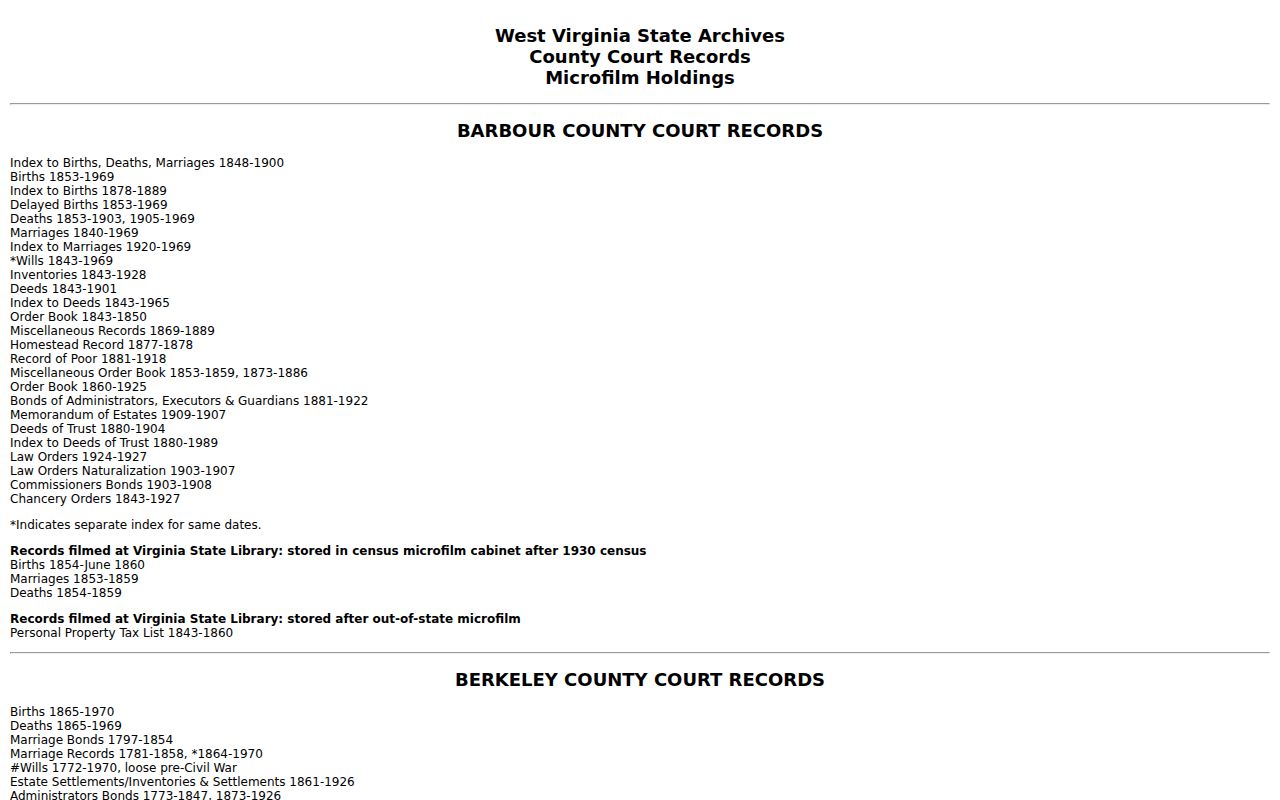
The image supports the archival fallback without claiming a live online deed index. A listed film is a holding lead until the relevant image, book, and page have been inspected.
Bluefield Previous Residents by Year
Bluefield directories provide the strongest dated household layer for much of the twentieth century. WV Archives lists selected years beginning in 1917-18, then 1923-24, 1932, mid-century volumes, long runs from 1970 through 1991 and 1993 through 2001, plus later volumes through 2016. Missing years matter. Do not fill a gap by assuming the same person stayed at the address.
Search both the alphabetical section and any reverse-street section. Transcribe the exact house number, street, name, initials, occupation, spouse or household mark, telephone, business, boarder, or roomer notation that the volume prints. Publisher conventions vary, so each field needs its year, page, repository, and image status.
The WV Archives directory holdings page identifies Bluefield volumes for this past-resident trail.
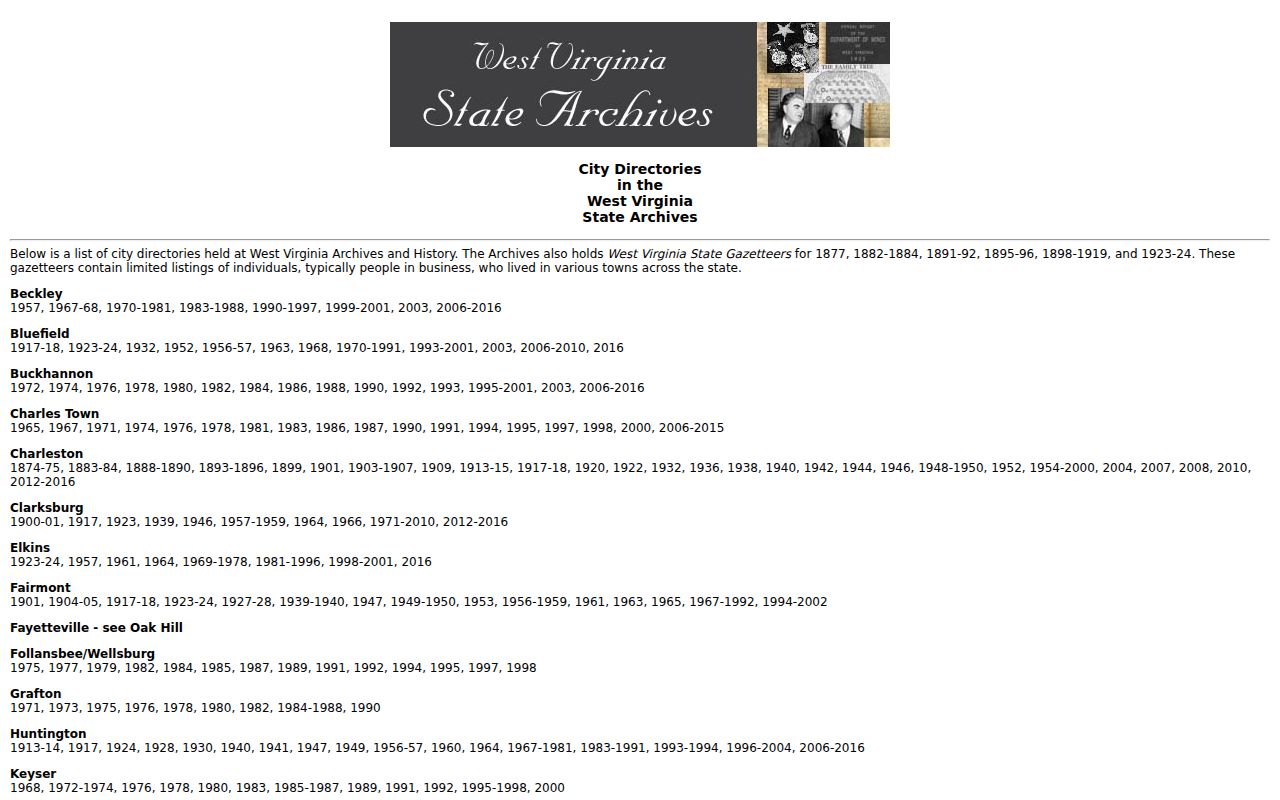
The holdings list tells a researcher which volume to request. It does not prove that every entry is indexed online or that a named listing was checked against the original page.
Pair Bluefield Household Records
One dated directory entry can be stale or incomplete. Pair it with another source near the same year before stating who lived here before. The full Bluefield historical shelf is described on the Bluefield city directory page; for house history, only the volumes surrounding an address transition are needed.
- Find the address in the nearest directory year and cite its exact printed form.
- Check the prior and next available years for a move, number change, vacancy, or new household notation.
- Compare a released census year or another dated public source where lawful and available. Keep household roles tied to that source.
- Use deeds to test ownership, not occupancy. Note when the owner and directory listing differ instead of choosing one.
- Add a map, permit, newspaper, or Board record only when it helps bridge the address across the same period.
Conflicting records are useful. They may show a move, a delayed publisher update, a change in ownership, or simply different record roles. Preserve both dated facts and leave the reason open unless a contemporaneous source resolves it.
Map Old Bluefield House Numbers
Sanborn fire-insurance maps help test whether an old and current address refer to the same place. Bluefield map context includes editions from 1893, 1897, 1902, 1907, 1910, 1914, and a 1922 Library of Congress set with 36 sheets. These maps can show footprints, building materials and use, lots, street labels, and nearby landmarks.
No official Bluefield-wide street renaming or renumbering list was found. When numbers conflict, compare the historic label and footprint, the modern parcel and legal description, and a record from the same date. Then search City Clerk ordinances, Board minutes, Engineering files, deeds, plats, or an NPS nomination for a bridge.
If that bridge is missing, say the connection is unresolved. Similar street names, close map positions, or a shared surname are not enough to merge two places.
Bluefield Newspapers Close the Gap
Craft Memorial Library holds the Bluefield Daily Telegraph from 1896 through 2017, but the run is not indexed. A narrow request saves time: provide a full name, exact death date, and place for an obituary search, or a short event window for another notice. Nonlocal research costs $5 for the first 30 minutes and each added half hour, plus 20 cents per copy and postage.
The Craft Memorial Library services page explains its local and nonlocal newspaper help.

A notice can supply a dated address, business, marriage, court, or death clue. Classify what it is and retain the newspaper title, date, and page. Omit living relatives and other private details that are not needed for the house trail.
Mercer Probate Address Clues
Probate can connect a decedent, estate representative, heirs, and property when a title trail ends at a death. Mercer County Clerk handles probate duties, while the Archives microfilm list includes wills from 1838 through 1969, a fiduciary index from 1837 through 1969, and sales and appraisements from 1886 through 1928.
Ask by estate name, approximate year, case, book, or page when known. A will, inventory, appraisal, estate order, or commissioner document may refer to the land. Recent or sensitive files may be restricted, so the Clerk is the source for current access and copy rules.
Probate names describe legal roles at an event. They are not a current family roster. Include only the link needed to explain the property transition.
Bluefield Coalfield Place Trails
The Eastern Regional Coal Archives at Craft adds a distinct layer for historic places tied to the Pocahontas Coalfield. Its holdings include company records, store books, maps, blueprints, photos, oral histories, ledgers, newspapers, railroad material, and scrip. Researchers should call for an appointment and ask for the narrowest collection or accession tied to a company, block, or place.
Coal records can explain a settlement, company building, store, route, or neighborhood. They do not authorize publication of private worker or customer files. Corroborate any person with a dated directory or newspaper and label occupation exactly as the historic source prints it.
This place-first method gives Bluefield house history its local context without turning an archive into a modern social map.
Protect Bluefield Past Households
Previous residents research should remain tied to a legitimate house, family, estate, or local-history question. Do not combine public sources to defeat a sealed record or a protected address. West Virginia's Address Confidentiality Program provides eligible victims with a substitute address, and both actual and substitute addresses require care.
Vital and court records also have firm limits. Birth records remain confidential for 100 years, while death, marriage, divorce, annulment, and fetal-death records have 50-year limits under state law. A released index or image can aid genealogy, but it is not permission to publish medical facts, full birth dates, or sensitive family links.
Lawful use. Trace Bluefield previous residents for house history, family research, or estate work. Never use an address trail to monitor, stalk, harass, threaten, or harm anyone.
Publish the source date, record role, confidence, and unresolved gap. The least precise fact that answers the historical question is usually the safest useful choice.