
Bluefield Directory Years on Record
Bluefield city directory research begins with a holdings list, not a single full-text database. The West Virginia Archives directory inventory identifies specific Bluefield volumes from 1917-18 through 2016. Craft Memorial Library appears as a repository in National Park Service research for South Bluefield. The West Virginia University Regional History Center holds newspaper microfilm that can bridge years between directories. NARA's circa-1930 guide points to material involving Bluefield, Princeton, and Bluefield, Virginia, making the exact volume and page essential.
| Collection | Years | Where Held | Access |
|---|---|---|---|
| West Virginia Archives volumes | 1917-18; 1923-24; 1932; 1952; 1956-57; 1963; 1968; 1970-91; 1993-2001; 2003; 2006-10; 2016 | West Virginia Archives | Holdings list; mediated access |
| Polk volumes cited by NPS | 1912-13, 1919-20, 1942, 1952, 1954-61, 1963-65, 1967 | Craft Memorial Library citation | Confirm volume and page |
| Telegraph microfilm | Oct. 1928-July 1967; Apr. 1968-Aug. 1971; Aug. 1978-Dec. 1985 | WVU Regional History Center | Repository-assisted microfilm |
| Bluefield Daily Telegraph | 1896-2017 | Craft Memorial Library | Not indexed; staff search available |
The runs are not continuous. A catalog entry also does not prove that a page has been viewed or digitized. Check adjacent years and alternate repositories when the needed book is absent. The known S. Watson Neel lead still requires inspection of the original page before it should be quoted as verified. Record whether a holding was merely identified or whether the image was actually read.
The official inventory shows how year-specific the shelf is. Review the linked source before using the captured reference below.
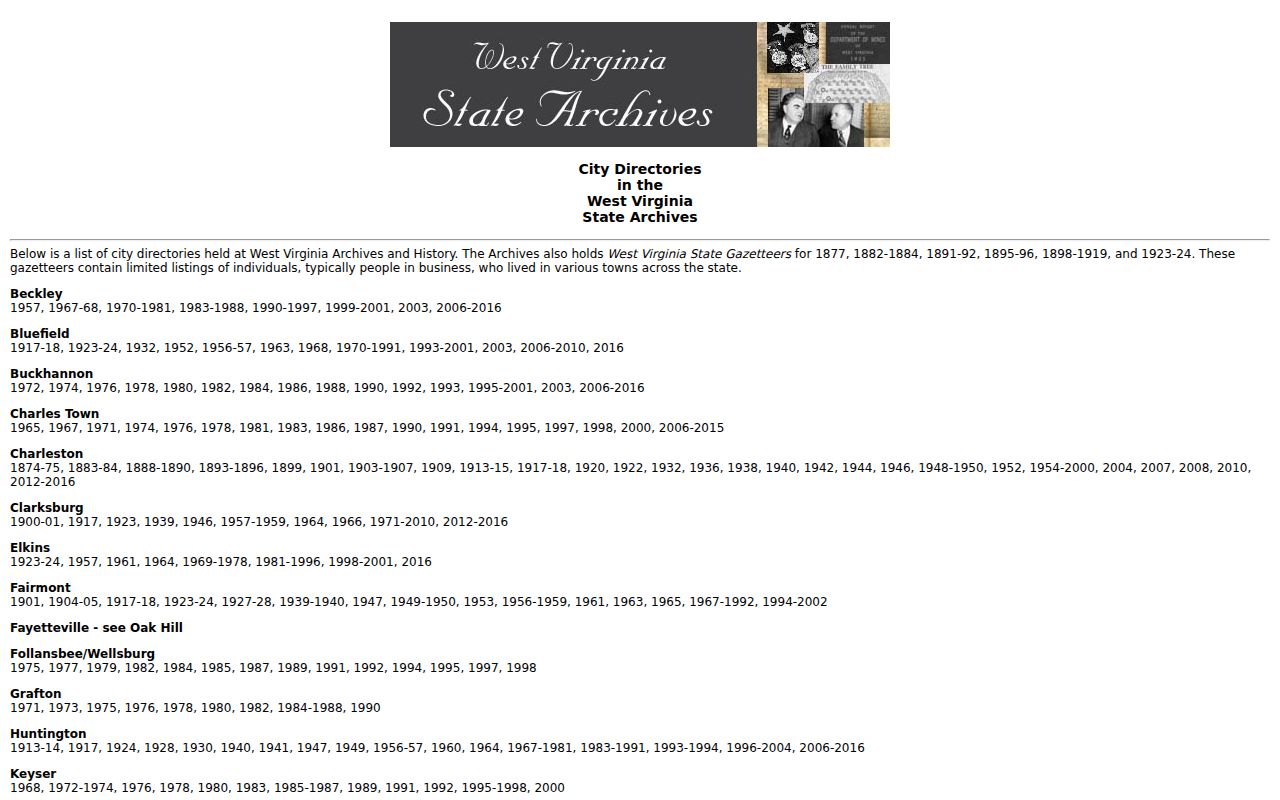
The capture is a route to the collection, not a searchable resident roll. Ask for the precise Bluefield year, publisher, page, and copy procedure.
Bluefield Archives Beyond Directories
Bluefield's local record trail extends beyond printed directories. Craft Memorial Library, at 600 Commerce Street, keeps the Telegraph file and offers obituary help. Local researchers may search with staff assistance. For a nonlocal request, provide a full name, exact death date, and place of death. The listed service costs $5 for the first 30 minutes, another $5 for each added half hour, 20 cents per copy, plus postage, paid by check or money order.
The Craft Memorial Library services page is the first check for current help and terms. Its capture confirms the local route available when an online city directory search ends at a catalog record.

Ask staff to preserve the newspaper title, date, and page with any copy. Those details turn a name match into a usable family-history citation.
Read Bluefield Directory Entries
A Bluefield city directory entry can pack several facts into one short line. Begin with the alphabetical section and copy it exactly, including initials and marks. Then save the abbreviation key from that same volume. Publisher practice changes by year, so a symbol learned from one book should not be imposed on another. Compare the reverse-street section, when present, to see how the address appeared among nearby house numbers.
| Name | Surname, given name, or initials as printed |
|---|---|
| Address | Street and house number for that publication year |
| Work line | Occupation or business role, treated only as historical context |
| Household note | Spouse, boarder, or roomer notation where included |
| Citation | Publisher, year, page, repository, and image or call number |
- Criss-cross directory
- A directory arranged by street and house number instead of only by surname.
- Householder index
- A list organized around a named householder, not a complete list of occupants.
- Abbreviation key
- The volume's own guide to shortened words and symbols. Conventions can differ by year.
Do not treat a spouse, boarder, telephone, or occupation note as a full household profile. It reflects a publisher's dated convention and can be stale. An entry supports a historical lead, while a second source should confirm the person, place, and time.
Bluefield Coalfield Directory Clues
The Eastern Regional Coal Archives at Craft adds the setting that terse city directories leave out. Its holdings include blueprints, company records, company-store books, diaries, maps, oral histories, photographs, railroad material, newspapers, scrapbooks, and scrip. An appointment is recommended through Craft at 304-325-3943 or cml@mail.mln.lib.wv.us. Ask for the narrowest box, volume, or call number tied to a historical name, firm, or address.
Coal records can explain an old workplace, camp, rail link, or neighborhood. They should not be used to infer a current household. Pair a company source with a dated directory or newspaper item, and label each person's role as printed. The 1983 Pocahontas Coalfield Centennial materials deposited at Craft are one local starting point.
Map Bluefield Directory Addresses
An address may stay legible while the street around it changes. The Library of Congress catalog identifies a 1922 Bluefield Sanborn set with 36 sheets, with earlier map context from 1893, 1897, 1902, 1907, 1910, and 1914. These fire-insurance maps show footprints, materials, uses, streets, and lot context. They do not name occupants by themselves.
Bluefield Historical Society material names Country Club Hill, Jefferson Street, South Bluefield, Upper Oakhurst, and Downtown. National Park Service research for South Bluefield points back to Polk directories and Craft. Use those aids to locate the right year and neighborhood, then verify the original entry. Do not quote the nomination as though it were the directory page.
Note: No official citywide street-renaming inventory was found, so an apparent number change remains unresolved until a deed, plat, map, or city record bridges it.
Bluefield Directory Timeline Gaps
The surviving record begins before the first volume on the West Virginia Archives list. National Park Service research cites a 1912-13 Polk directory at Craft, followed by 1919-20. The state inventory then identifies 1917-18 and 1923-24. Later references become denser in the 1950s and 1960s, while the Archives list offers a near-annual run from 1970 through 1991. It resumes with gaps through 2016.
| Period | Research approach |
|---|---|
| 1910s-1920s | Check NPS citations, Craft holdings, Archives volumes, Sanborn maps, and newspapers. |
| 1930s-1960s | Use the identified directory years with WVU newspaper microfilm and exact-page requests. |
| 1970s-1990s | Follow the denser Archives run year by year, noting every missing volume. |
| 2000s-2016 | Request only the listed years and verify whether access is onsite, copied, or mediated. |
A year absent from the online holdings list should be called “not identified in the searched inventory,” not “never published.” FamilySearch, WVU, Craft, NARA, and other catalogs may identify an alternate copy. Repository staff can also clarify whether a book is under another title or combined with a nearby place.
Verify Bluefield Directory Images
The safest citation records the title, publisher, year, page, repository, and image or call number. It also says whether the page was seen. A holdings list can guide a request but cannot establish the text of an entry. NARA material around 1930 may combine references to Bluefield, Princeton, and Bluefield, Virginia, so state and repository must remain attached to every note.
The Archives also describes Mercer County microfilm for deeds from 1837 to 1904 and deed indexes through 1968. Those records can test whether the same family owned a parcel, but ownership is not residence. For the modern address trail, use the Bluefield street directory after the historical citation is secure.
Trace Families in Bluefield Directories
A family trail is strongest when each step stays tied to a date. Start with the most certain name and year. Work through Bluefield city directories in both directions, noting address changes rather than assuming every gap means a move or death. Use census years, newspapers, deeds, vital indexes, and maps to test changes between volumes.
- Find the earliest solid surname entry, then record the full citation and exact spelling.
- Check prior and later volumes for a move, new initial, spouse note, or changed work line.
- Use the reverse-street section, when available, to confirm the printed house-number sequence.
- Compare census years and historical vital indexes without treating either as a current roll.
- Close a gap with a dated newspaper search, deed index, Sanborn sheet, or repository file.
A disappearance has several possible causes. The person may have moved, died, been omitted, used another name form, or fallen into a missing publication year. Search spelling variants and initials before drawing a conclusion. If a death date is known, Craft's obituary route can add a page citation. If an address changes, compare a Sanborn footprint, deed or plat description, and city minutes before declaring that two house numbers describe the same place.
Keep conflicts visible. A directory may place a person at one address while a deed names a different owner. Report both dated facts and the record role. That practice preserves what each source truly shows.